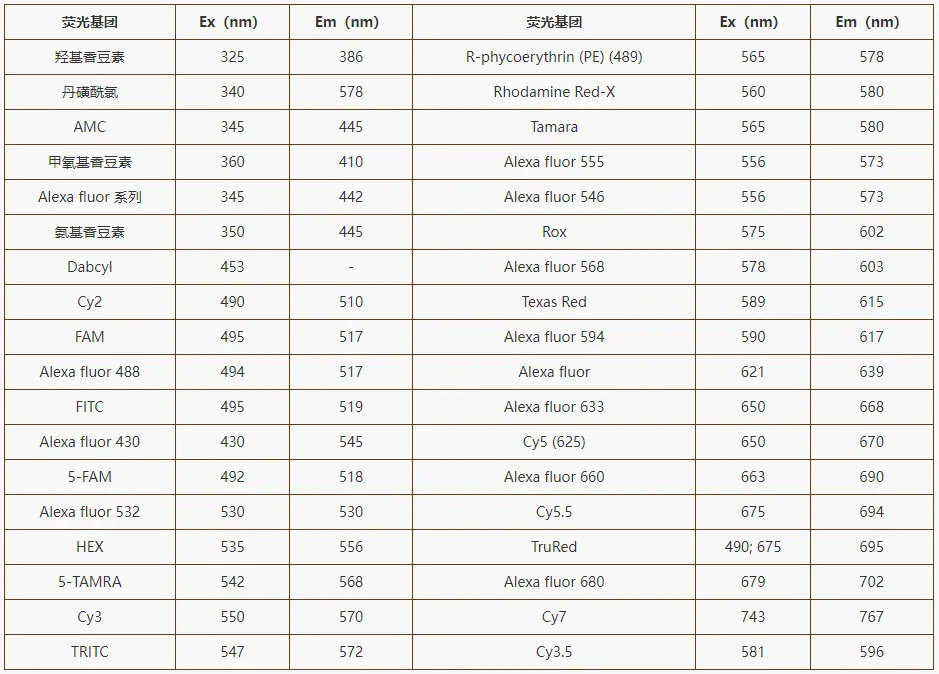




Peptide fluorescent labeling is non-radioactive and the experimental operation is simple. Therefore, peptide fluorescent labeling is widely used in biological research. The peptide fluorescent labeling method is related to the structure of the fluorescent reagent. The method used for free carboxyl groups is the same as the peptide-linking reaction, and the HBTU/HOBt/DIEA method is also used for connection. The peptide labeled with FITC at the N-terminus needs to undergo cyclization to form fluorescein, which is usually accompanied by the removal of the last amino acid, but when there is a spacer such as aminocaproic acid, or the target peptide is cut from the resin in a non-acidic environment, this situation can avoid being cut by TFA during the cutting process.
People use fluorescently labeled peptides to detect the activity of target proteins, and apply the high-throughput activity screening methods they have developed to drug screening and drug development of target proteins for disease treatment (for example, various kinases, phosphatases, peptidases, etc.).
Goutuo Biochemical can provide a variety of mature fluorescent labeled peptides.
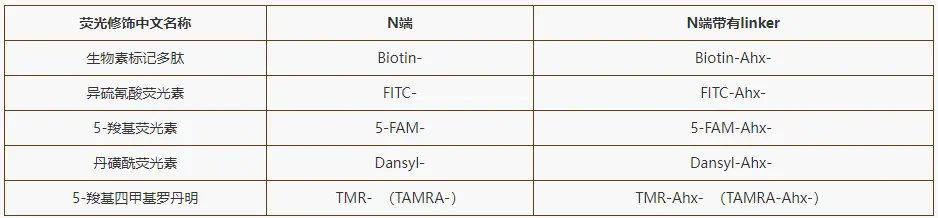
The following are some common structures of peptide-modified fluorescent substances:

FITC labeling
FITC (fluorescein isothiocyanate) has a relatively high activity. Our company can label FITC on peptides in two ways: (1) labeling FITC on the side chain amino group of lysine (Lys) or selectively deprotected ornithine; (2) labeling FITC on the N-terminal amino group of the peptide.
When labeling at the N-terminus, it is recommended to introduce an alkyl spacer, such as aminohexanoic acid (Ahx), between the last amino group and the thiourea bond generated by the reaction of isothiocyanate and amino groups. Linking cleavage requires an acidic environment. Peptides labeled with FITC at the N-terminus undergo cyclization to form fluorescein, which is usually accompanied by the removal of the last amino acid, but this can be avoided when there is a spacer such as aminohexanoic acid, or when the target peptide is cleaved from the resin in a non-acidic environment. Steric hindrance is believed to be the main reason for using Ahx before fluorescent dyes, rather than the reason why FITC cannot be directly coupled to peptides.
Either Ahx or b-Ala can be used as spacers in FITC-labeled peptides.
Common fluorescence modification
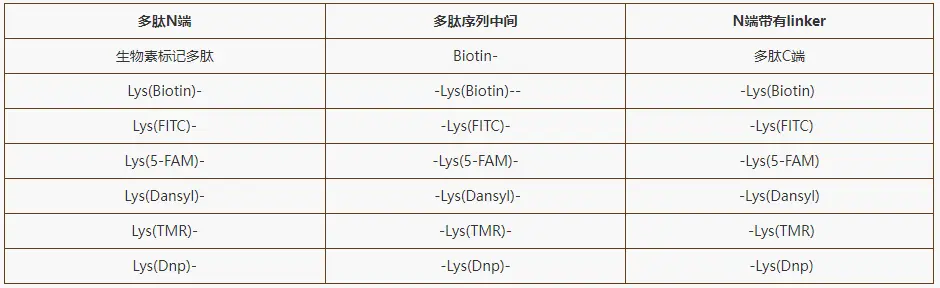
Fluorescence modification via Lys side chain amino group attachment
The excitation light wavelength and emission light wavelength of the fluorescent materials commonly used by GUTO. For reference: