




For men's health, prostate cancer is an issue that cannot be ignored—it is the second leading cause of cancer death in men in the United States and Europe.
The traditional treatment for advanced prostate cancer is “androgen deprivation therapy (ADT)”: controlling cancer cell growth by reducing androgen secretion from the testes. However, a challenge inevitably arises: some patients progress to “castration-resistant prostate cancer (CRPC)”. Even when androgen levels in the body have dropped to castrate levels, the adrenal glands and even the prostate cancer tissue itself can still synthesize androgens, allowing cancer cells to continue proliferating. In the past, the addition of antiandrogen drugs could temporarily lower androgen levels but failed to truly extend patients' overall survival. CRPC was once a tough nut to crack in clinical treatment.
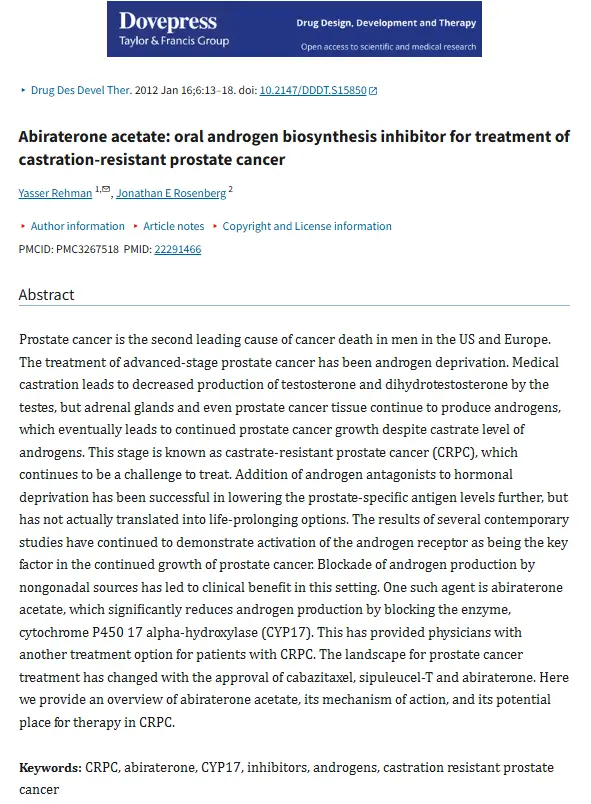
Fortunately, there is a new breakthrough. A 2012 study published in《Drug Design, Development and Therapy》 introduced an oral drug targeting CRPC—“abarelix acetate (CAS No. 183552-38-7)”, an androgen synthesis inhibitor with a precise core mechanism: It targets “cytochrome P450 17α-hydroxylase (CYP17)”, the key enzyme in the androgen synthesis pathway. Androgen production in the gonads, adrenal glands, and even cancerous tissue is dependent on this enzyme. By blocking CYP17, abarelix acetate cuts off the "androgen fuel" for CRPC cancer cells, which is the critical mechanism underlying its clinical benefit.
Clinical data have also shown positive signals: when combined with prednisone, it significantly prolongs both progression-free survival and overall survival in patients with metastatic CRPC. Since its approval in the United States in 2011, together with drugs such as cabazitaxel and Sipuleucel-T, it has completely transformed the treatment landscape of CRPC.

However, attention should be paid to medication risks. The LiverTox database of the U.S. National Library of Medicine (NIH) notes that abarelix acetate may cause elevated liver enzymes and even rare but severe acute liver injury. Common side effects include fatigue, nausea, and diarrhea. The combination with prednisone is precisely to prevent possible hypocortisolism induced by the drug. Therefore, regular monitoring of liver function is required during medication, and medical advice should be followed throughout the treatment process.
From "no available drugs" to "having new options", the emergence of abarelix acetate epitomizes the clinical research approach of "targeting mechanisms to precisely solve problems". For patients with refractory cancer, every such breakthrough represents an extra glimmer of hope for survival.