




Orforglipron, an oral non-peptide, selective GLP-1 receptor partial agonist, has demonstrated for the first time significant glucose-lowering and weight-reducing effects in patients with early-stage type 2diabetesas a monotherapy .
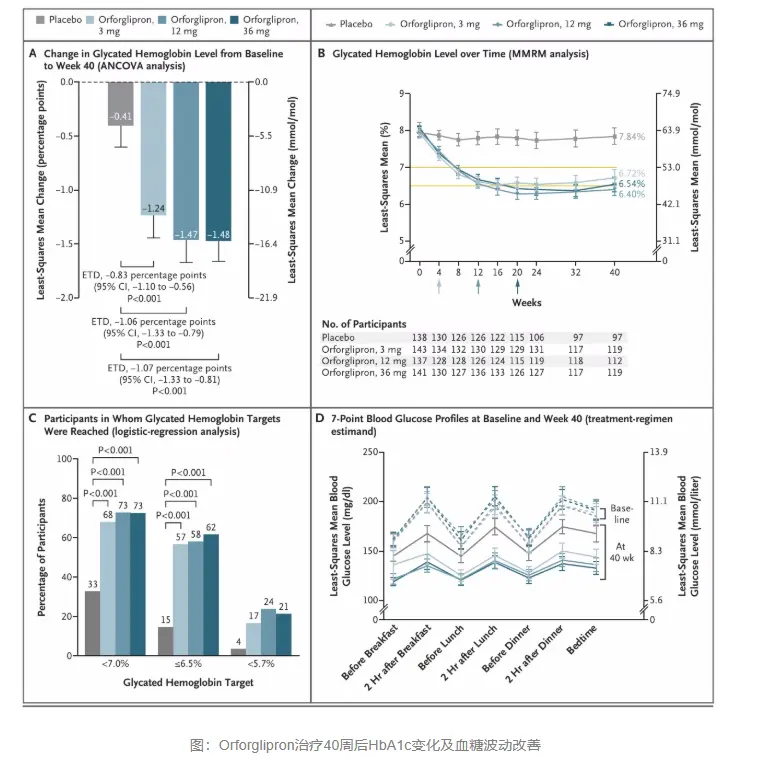
After 40 weeks of treatment, Orforglipron reduced glycated hemoglobin (HbA1c) by an average of 1.24 to 1.48 percentage points, significantly better than placebo.
The main side effects were mild to moderate gastrointestinal adverse reactions, and the dose escalation regimen effectively improved tolerance, with no reports of severehypoglycemiaevents.
Research Overview
On June 21, a multicenter, randomized, double-blind, placebo-controlled Phase III clinical trial (ACHIEVE-1) published in the New England Journal of Medicine reported on the safety and efficacy of orforglipron inpatients with early-stage type 2 diabetes. The study enrolled 559 adults with type 2 diabetes who were unable to control their blood sugars with diet and exercise. The patients were randomly assigned to receive orforglipron (3 mg, 12 mg, or 36 mg) or placebo for 40 weeks. The results showed that orforglipron significantly reduced HbA1c and body weight and was well tolerated, providing strong clinical evidence for the development and application of a new generation of oral GLP-1 drugs.
Background
GLP-1 receptor agonists have established an important positioninthe management oftype 2 diabetes due to their mechanism of enhancing insulin secretion and being glucose-dependent . In addition, they can also bringadditional benefits such as weight loss and cardiovascular protection. Currently, most GLP-1 agonists are peptide drugs that require subcutaneous injection, which limits patient compliance. The concept of oral GLP-1 agonists has attracted attention due to its convenience of administration, but due to the large molecular characteristics of the drug and absorption limitations, existing oral preparations (such as oral Semaglutide) require special medication conditions (taking on an empty stomach and limiting water intake) to ensure efficacy. Non-peptide small molecule GLP-1 agonists have become aresearch and developmenthotspot due to their better oral bioavailability and simplified medication conditions.
Orforglipron, an innovative, non-peptide, small-molecule GLP-1 receptor agonist, exhibits potent selectivity and a bias toward G protein signaling activation. It is expected to maintain the efficacy of GLP-1 while potentially improving tolerability and patient acceptance for oral administration. This study aims to investigate the efficacy and safety of orforglipron as a monotherapy in patients with early-stage type 2 diabetes.
Research Methods
This study was a 40-week, multinational, multicenter, randomized, double-blind, placebo-controlled Phase III clinical trial. Adults with type 2 diabetes (HbA1c) between 7.0% and 9.5%, a BMI ≥ 23, and controlled diet and exercise alone were enrolled. Patients were randomly assigned in a 1:1:1:1 ratio to receive orforglipron 3 mg, 12 mg, 36 mg, or placebo, administered orally once daily, based on a dose-escalation schedule (starting at 1 mg and increasing gradually to the target maintenance dose). The primary endpoint was the change in HbA1c after 40 weeks of treatment; key secondary endpoints included changes in weight and multiple metabolic markers.
Statistical evaluation methods appropriate to the treatment course were used,and data were analyzed according to the intention-to-treat principle, with appropriate multiple imputation of missing values. Safety analyses included adverse event monitoring, with particular attention to hypoglycemia and gastrointestinal reactions.
Study Results
A total of 559 patients were randomly assigned, with a balanced baseline
distribution. The mean age was 53.4 years, the initial HbA1c was approximately 8.0%, the mean weight was 90.2 kg, and the BMI was approximately 33. Nearly half were women. The diverse ethnic and geographic populations represented a typical patient population with early-stage type 2 diabetes.After 40 weeks, HbA1c changes
in the 3 mg, 12 mg, and 36 mg dose groups decreased by 1.24, 1.47, and 1.48 percentage points, respectively, which were significantly better than the placebo group (which only decreased by 0.41 percentage points); the mean differences between the treatment group and the placebo group were -0.83, -1.06, and -1.07 percentage points, respectively, which were statistically significant (P<0.001).The proportion of patients achieving their target HbA1c
(HbA1c) of <7% in the Orforglipron group was 68%-73%, significantly higher than the 33% achieved with placebo. The proportion of patients achieving HbA1c ≤6.5% was 57%-62%, compared to only 15% with placebo. Among patients achieving near-normoglycemia (HbA1c <5.7%), the proportion in the Orforglipron group was 17%-24%, compared to only 4% with placebo.Improved fasting blood glucose and blood glucose variability:
Fasting blood glucose decreased by 31-37 mg/dL compared to baseline, compared to 11 mg/dL for placebo (P<0.001). Seven-point blood glucose monitoring showed significant improvements in pre-meal and post-meal blood glucose levels and blood glucose variability.Weight Change:
Orforglipron 3 mg, 12 mg, and 36 mg groups experienced 4.5%, 5.8%, and 7.6% decreases from baseline, respectively, compared to a 1.7% decrease in the placebo group. The 12 mg and 36 mg groups experienced significantly greater weight loss than the placebo group (12 mg, -4.1% difference; 36 mg, -5.9% difference, P < 0.001). The proportion of patients experiencing greater than 5% weight loss ranged from 43% to 61%, and significantly more patients experienced 10% and 15% weight loss compared to the placebo group.Changes in lipid profiles and blood pressure:
Triglycerides significantly decreased in the 12 mg and 36 mg dose groups, and non-HDLcholesterolsignificantlydecreased in the 36 mg dose group. Systolic blood pressure decreased by 3.3-5.7 mmHg compared to baseline in the orforglipron group, compared to a 1.2 mmHg decrease in the placebo group, contributing to improvements incardiovascular risk. Pulse rate was slightly elevated, but otherwise normal.Safety:
Most adverse events were mild to moderate gastrointestinal reactions (diarrhea, nausea, dyspepsia, etc.), primarily concentrated during the dose-escalation phase and gradually decreasing over time. Discontinuation rates due to gastrointestinal adverse reactions were low (2.2%-5.7%), with no discontinuations in the placebo group. No cases of severe hypoglycemia were observed, and no specific adverse events such aspancreatitisandthyroid cancerwere observed . None of the four deaths were considered drug-related. The overall safety profile was favorable, consistent with the safety profile of GLP-1 drugs
Research value and significance
This study is the first to systematically evaluate the efficacy and safety of orforglipron, an oral, non-peptide, small molecule GLP-1 receptor agonist, as monotherapy in patients with early-stage type 2 diabetes. Data demonstrated that orforglipron not only significantly lowered blood glucose and HbA1c to clinical targets, but also significantly reduced weight and improved cardiovascular risk factors, demonstrating the multiple metabolic advantages of GLP-1 receptor agonists. Its oral administration and the convenience of not requiring fasting significantly improve patient compliance, potentially breaking through the bottleneck of injectable medications.
Furthermore, the stability of orforglipron's efficacy and good tolerability over 40 weeks demonstrate its potential for long-term treatment and provide a new option for early intervention. Future studies involving extended treatment durations, expanded populations (including combined use with multiple oral/injectable antidiabetic medications), and cardiovascular safety trials will provide more comprehensive evidence for orforglipron's clinical positioning and promotion.
As a non-peptide, small-molecule GLP-1 agonist, orforglipron, with its high oral bioavailability and simple dosing regimen, will significantly improve the patient experience. This study demonstrated significant glucose-lowering and weight-loss effects in patients with early-stage type 2 diabetes, along with good gastrointestinal tolerability and a safety profile consistent with existing GLP-1 drugs. Future studies could focus on its synergistic effects in combination with other oral hypoglycemic agents or even injectable medications, as well as its clinical manifestations in different populations, to expand the boundaries of clinical application. We hope that orforglipron will become a new tool for improving patient compliance and blood sugar management." - Dr. Meis Zhang