




Recently, two new studies on FOXO4-DRI (CAS No.: 2460055-10-9) have been making waves in the scientific community. This peptide, designed for targeted senescent cell elimination, has shown intriguing performance across different tissue contexts.
First, let us talk about senescent cells—whether in in vitro cultures or in vivo lesions, these "dormant yet disruptive" cells secrete a host of SASP inflammatory factors that disrupt the surrounding microenvironment. They are the "hidden culprits" behind stalled tissue repair and recurrent proliferative disorders. Senolytics like FOXO4-DRI are promising candidates that can precisely "clear" these cells without harming healthy ones.

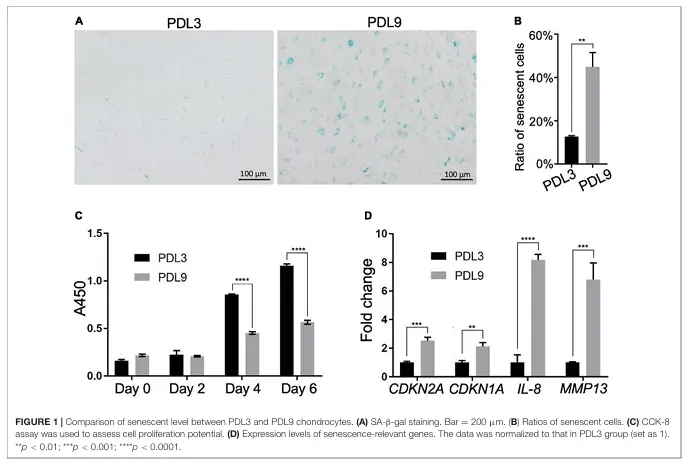
In the paper Senolytic Peptide FOXO4-DRI Selectively Removes Senescent Cells From in vitro Expanded Human Chondrocytes published by Huang et al., in vitro expansion of human chondrocytes is a common practice for articular cartilage repair. However, repeated passaging tends to induce cellular senescence—SA-β-gal staining revealed that the proportion of senescent cells at population doubling level 9 (PDL9) was nearly twice as high as that at the early passage stage (PDL3). Concurrently, cell proliferation capacity plummeted, and the expression of senescence- and inflammation-related genes such as CDKN2A and IL-8 surged dramatically. Treatment with FOXO4-DRI selectively eliminated these senescent chondrocytes, restored cell proliferation, and suppressed SASP factor expression. This represents a critical breakthrough for chondrocyte transplantation, effectively solving the long-standing problem of "cells aging before clinical application".

A 2025 study by the Kong team, published in Communications Biology (doi:10.1038/s42003-025-07738-0), focused on the intractable condition of keloids. Senescent fibroblasts in keloids continuously secrete SASP, driving hyperplasia and recurrence. FOXO4-DRI exerts its effect by promoting the nuclear export of "p53 serine 15-phosphorylated", precisely inducing apoptosis of these senescent fibroblasts and fundamentally cutting off the "driving force" of keloid overgrowth.
Notably, FOXO4-DRI is a D-enantiomeric retro-inverso peptide, inherently endowed with protease resistance and strong cell permeability—these are the "structural advantages" that enable it to penetrate cells smoothly and exert its function.
Currently, FOXO4-DRI is still in the in vitro and animal experiment stages.Nevertheless, the positive outcomes in two distinct scenarios—chondrocyte preparation for cartilage repair and lesion intervention for keloids—have demonstrated its potential as a senolytic tool. If subsequent clinical research can advance successfully, it may offer a reliable new option in fields such as tissue regeneration and the treatment of proliferative disorders.