




Keyword:Mazdutide,2259884-03-0,Mazdutide Peptide
In the rapidly evolving landscape of metabolic disorder treatments, Mazdutide (IBI362, also known as LY3305677 or OXM3) has emerged as a groundbreaking dual-target agonist, redefining therapeutic approaches for obesity and type 2 diabetes (T2D). Developed through a collaboration between Eli Lilly and Innovent Biologics, this once-weekly injectable peptide is a synthetic analog of mammalian oxyntomodulin, uniquely designed to activate both the glucagon-like peptide-1 receptor (GLP-1R) and the glucagon receptor (GCGR). Unlike single-target GLP-1 agonists that dominate the current market, Mazdutide’s dual mechanism delivers synergistic benefits—superior weight loss, robust glycemic control, and comprehensive metabolic improvements—making it one of the most anticipated metabolic therapies of the decade. Below, we explore its molecular structure, mechanism of action, clinical efficacy, safety profile, and transformative potential for patients, backed by peer-reviewed research and optimized for search visibility.
The Molecular Basis: A Dual Agonist Rooted in Oxyntomodulin
Mazdutide’s design is rooted in the body’s natural metabolic signaling. It is engineered as a long-acting analog of oxyntomodulin (OXM), a gut-derived peptide secreted postprandially that naturally co-activates GLP-1R and GCGR to regulate energy balance. Chemically, it is a 37-amino acid peptide with a molecular formula of C₂₁₀H₃₂₂N₄₆O₆₇ and a molar mass of 4563.14 g·mol⁻¹, modified to extend its half-life—enabling weekly subcutaneous administration via prefilled autoinjector, a key advantage for patient adherence. Its dual affinity is precisely tuned: it binds to human GLP-1R with a Ki of 28.6 nM and to GCGR with a Ki of 17.7 nM, balancing activation of both receptors to avoid the glucagon-induced hyperglycemia seen with unregulated GCGR agonism. This structural precision is what sets Mazdutide apart: it merges the glucose-stabilizing, appetite-suppressing effects of GLP-1R activation with the energy-boosting, fat-burning properties of GCGR activation, creating a holistic solution for metabolic dysfunction. A 2022 study in eClinicalMedicine confirmed that this dual-receptor design is essential to its enhanced efficacy, with structural modifications preserving OXM’s native activity while prolonging circulation time.
Mechanism of Action: Synergistic Control of Glucose, Weight, and Metabolism
Mazdutide’s therapeutic power lies in its multi-system mechanism, acting across the brain, pancreas, liver, and adipose tissue to restore metabolic balance. First, via GLP-1R activation, it mimics the body’s glucose-regulating signals: it stimulates glucose-dependent insulin secretion from pancreatic β-cells, suppresses glucagon release (preventing excess glucose production), and slows gastric emptying—prolonging satiety and reducing food intake. Centrally, it targets hypothalamic appetite centers, lowering cravings and reducing overall caloric consumption, a core effect for weight management. Complementing this, GCGR activation drives critical metabolic benefits: it boosts hepatic fat oxidation, accelerating breakdown of liver fat and reducing hepatic steatosis (a hallmark of metabolic dysfunction-associated fatty liver disease, MASLD). It also promotes white adipose tissue browning—converting energy-storing white fat into energy-burning brown fat—significantly increasing resting energy expenditure and facilitating greater fat loss than GLP-1 mono-agonists. Additionally, GCGR agonism modulates purine metabolism, lowering uric acid levels and reducing gout risk, while improving lipid profiles (reducing triglycerides and LDL cholesterol) and blood pressure. This dual-receptor synergy means Mazdutide addresses not just weight and glucose, but the full spectrum of metabolic risk factors—filling a critical gap in care for patients with overlapping obesity, diabetes, and fatty liver disease.
Clinical Efficacy: Breakthrough Results in Obesity and Type 2 Diabetes
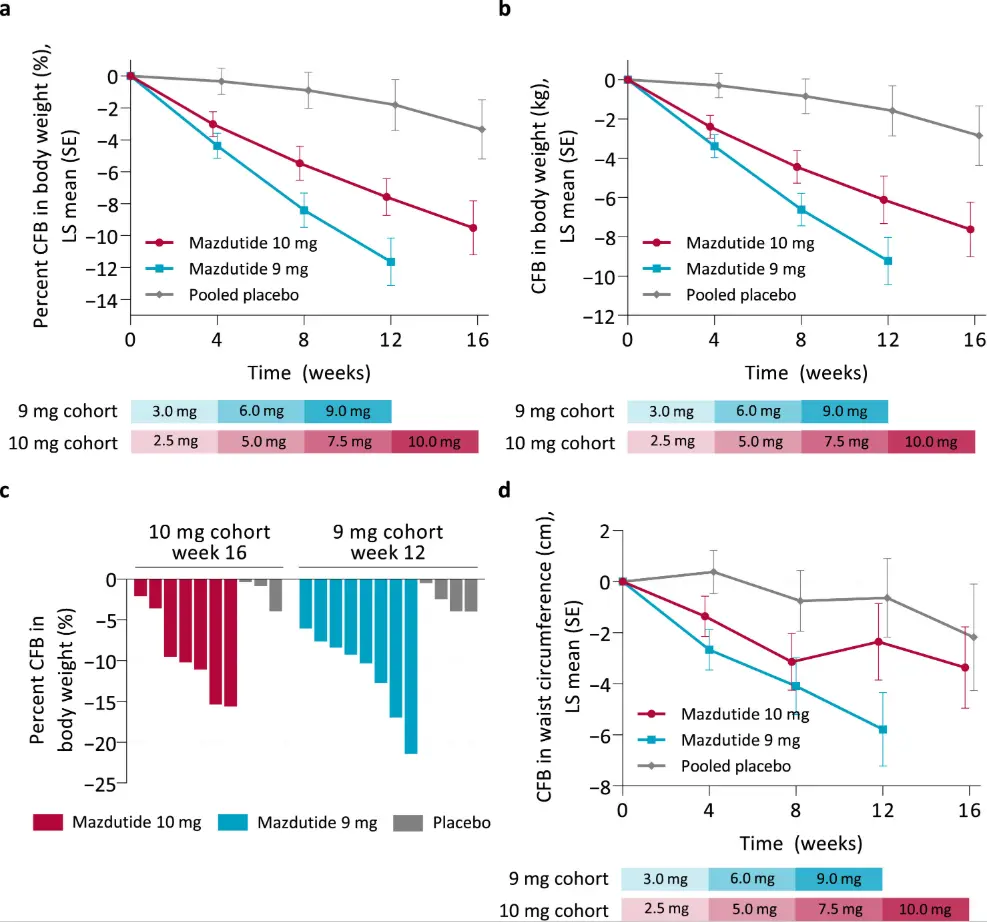
Mazdutide’s clinical performance has been transformative, with Phase 2 and 3 trials validating its superior efficacy across key metabolic endpoints. For obesity, the landmark Phase 3 GLORY-1 trial (published in The New England Journal of Medicine, 2025) evaluated 48 weeks of once-weekly Mazdutide in Chinese adults with obesity (BMI ≥28 kg/m²) or overweight (BMI ≥24 kg/m²) with comorbidities. The 6 mg dose achieved a mean weight reduction of 15.6%—nearly double the efficacy of many single-target GLP-1 agonists—with 78% of patients losing ≥10% of body weight and 45% losing ≥15%. Waist circumference, visceral fat, and cardiometabolic markers (triglycerides, HbA1c, blood pressure) also improved significantly. For T2D, a Phase 3 trial (2025) showed that 24 weeks of Mazdutide 6 mg reduced HbA1c by 2.15% (vs. 0.14% with placebo) and body weight by 7.8%, outperforming dulaglutide (a leading GLP-1 mono-agonist) in both glucose control and weight loss. Phase 2 data further confirmed dose-dependent benefits: 9 mg Mazdutide delivered up to 18.2% weight loss over 48 weeks, with sustained efficacy and no tolerance development. A 2026 meta-analysis in Frontiers in Endocrinology consolidated these findings, concluding Mazdutide achieves greater weight reduction and glycemic control than placebo and GLP-1 mono-agonists, with consistent benefits in diabetic and non-diabetic populations. These results led to China’s NMPA approving Mazdutide in June 2025 for long-term weight management, and in September 2025 for T2D glycemic control—marking its first global approvals.
Safety and Tolerability: Favorable Profile Aligned with GLP-1 Class
Mazdutide’s safety profile aligns with well-tolerated GLP-1 receptor agonists, with most adverse events being mild-to-moderate and transient. Gastrointestinal effects—nausea, diarrhea, constipation, and decreased appetite—are the most common, typically occurring during dose titration and diminishing over time. In Phase 3 trials, only 3-5% of patients discontinued treatment due to adverse events, a rate comparable to marketed GLP-1 agonists. Hypoglycemia is rare (≤2% incidence) and mild, as GLP-1R activation is glucose-dependent. No treatment-related serious adverse events or liver/kidney toxicity were reported, and antibody formation (22.6-32.8% of patients) did not impact efficacy or safety. A 2025 PMC study confirmed its favorable tolerability across doses (3-9 mg), with no unexpected safety signals and consistent quality of life improvements. This safety-efficacy balance positions Mazdutide as a viable long-term therapy for chronic metabolic conditions.
Clinical Implications and Future Potential
Mazdutide’s approval marks a paradigm shift in metabolic care, offering a first-in-class dual agonist for patients unresponsive to lifestyle changes or single-target therapies. It addresses a critical unmet need: 11.1% of chronic disease deaths in China are linked to overweight/obesity, with limited sustainable pharmacotherapy options. Beyond obesity and T2D, ongoing trials explore its utility in MASLD, obstructive sleep apnea, and alcohol use disorder—areas where its dual metabolic and anti-inflammatory effects show promise. As a once-weekly injectable, it improves adherence over daily therapies, while its comprehensive metabolic benefits reduce the need for multiple medications. With global clinical trials underway, Mazdutide is poised to become a cornerstone of metabolic disorder treatment worldwide.
Key Takeaways
Mazdutide (IBI362) is a revolutionary GLP-1R/GCGR dual agonist that redefines metabolic disorder treatment. Its oxyntomodulin-based design delivers synergistic weight loss, glycemic control, and metabolic improvements—outperforming single-target therapies in clinical trials. With a favorable safety profile, once-weekly dosing, and approvals for obesity and T2D, it addresses critical gaps in care for millions with metabolic dysfunction. As research expands, its potential to treat MASLD and other comorbidities solidifies its role as a transformative, multi-purpose metabolic therapy.