




Keyword:Pasireotide,396091-73-9
Pasireotide is a synthetic peptide drug used primarily in the treatment of endocrine disorders such as Cushing’s disease and acromegaly. As a next-generation somatostatin analog, pasireotide is designed to regulate hormone secretion by targeting multiple somatostatin receptor subtypes. Its unique receptor-binding profile distinguishes it from earlier therapies and makes it particularly effective in conditions driven by excessive hormone production.
Understanding how pasireotide works requires exploring its interaction with somatostatin receptors and its downstream effects on hormone regulation, especially in the pituitary gland and other endocrine tissues.
What Is Pasireotide?
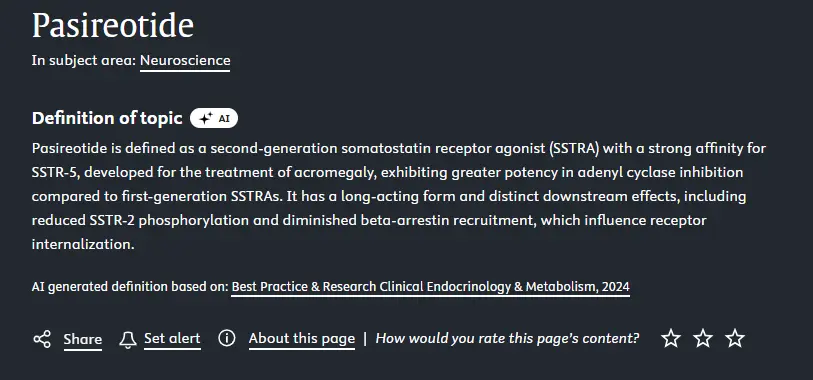
Pasireotide is a cyclohexapeptide analog of the natural hormone somatostatin. It is marketed under brand names such as Signifor and Signifor LAR and is approved for the treatment of Cushing’s disease and acromegaly in patients who are not suitable candidates for surgery or have not responded adequately to other treatments.
Somatostatin is a regulatory hormone that inhibits the release of several other hormones, including growth hormone (GH), adrenocorticotropic hormone (ACTH), and insulin. Pasireotide mimics these inhibitory effects but with enhanced potency and broader receptor activity.
Mechanism of Action: Binding to Somatostatin Receptors
The primary mechanism of action of pasireotide is its ability to bind to somatostatin receptors (SSTRs). There are five known subtypes of these receptors (SSTR1–SSTR5), which are distributed across various tissues in the body.
Unlike earlier somatostatin analogs such as octreotide, pasireotide has a high affinity for multiple receptor subtypes, particularly SSTR1, SSTR2, SSTR3, and most importantly SSTR5. This broad receptor binding allows it to exert stronger and more comprehensive inhibitory effects on hormone secretion.
When pasireotide binds to these receptors, it activates intracellular signaling pathways that reduce cyclic AMP (cAMP) production and inhibit calcium influx. These changes suppress the secretion of hormones from endocrine cells.

Inhibition of ACTH in Cushing’s Disease
One of the most important clinical applications of pasireotide is in the treatment of Cushing’s disease, a condition characterized by excessive cortisol production.
In Cushing’s disease, a pituitary tumor produces excess ACTH, which stimulates the adrenal glands to release cortisol. Pasireotide works by binding to SSTR5 receptors on pituitary corticotroph tumor cells, thereby inhibiting ACTH secretion.
As ACTH levels decrease, cortisol production is reduced, helping to restore hormonal balance and alleviate symptoms such as weight gain, hypertension, and glucose intolerance.

Suppression of Growth Hormone in Acromegaly
Pasireotide is also used in the treatment of acromegaly, a disorder caused by excessive secretion of growth hormone (GH), usually from a pituitary adenoma.
By activating somatostatin receptors on growth hormone–secreting cells, pasireotide reduces GH release. This, in turn, lowers levels of insulin-like growth factor-1 (IGF-1), which mediates many of the disease’s symptoms.
Because of its broader receptor affinity, pasireotide may be effective in patients who do not respond adequately to first-generation somatostatin analogs.
Effects on Insulin and Glucose Metabolism
An important aspect of how pasireotide works is its impact on glucose metabolism.
While it effectively suppresses hormones like ACTH and GH, pasireotide can also inhibit insulin secretion from pancreatic beta cells due to its activity on somatostatin receptors in the pancreas. This can lead to elevated blood glucose levels and, in some cases, hyperglycemia.
This side effect is a key consideration in clinical use and often requires monitoring and management, especially in patients with diabetes or prediabetes.
Advantages Over First-Generation Somatostatin Analogs
Compared to earlier drugs like octreotide and lanreotide, pasireotide offers several advantages.
Its ability to bind multiple somatostatin receptor subtypes, particularly SSTR5, makes it more effective in certain patients, especially those with Cushing’s disease. It also provides an alternative for patients who are resistant to first-generation therapies.
However, its broader activity also contributes to a higher likelihood of metabolic side effects, particularly related to glucose regulation.


Clinical Applications and Administration
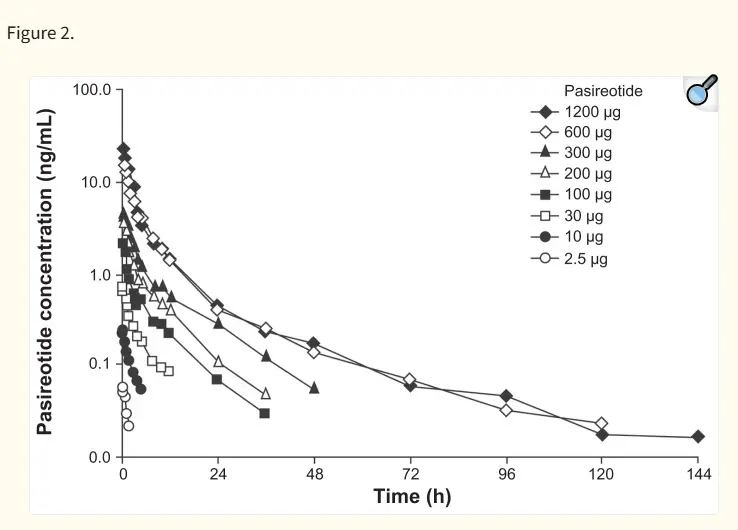
Pasireotide is available in both short-acting and long-acting formulations. The long-acting release (LAR) version allows for monthly dosing, improving patient convenience and adherence.
It is typically prescribed for patients who cannot undergo surgery or whose disease persists after surgical intervention. In these cases, pasireotide provides a pharmacological approach to controlling hormone levels.
Ongoing research is also exploring additional applications of pasireotide in other endocrine and neuroendocrine disorders.
Conclusion
Pasireotide works by binding to multiple somatostatin receptor subtypes and inhibiting the secretion of key hormones such as ACTH and growth hormone. Its broad receptor activity makes it a powerful tool in the treatment of endocrine disorders like Cushing’s disease and acromegaly.
While its mechanism offers significant therapeutic benefits, it also affects glucose metabolism, requiring careful monitoring during treatment. As a next-generation somatostatin analog, pasireotide represents an important advancement in hormone-targeted therapy.