




In the field of neuroscience and mental health research, the search for potential therapeutic molecules with high efficacy and low toxicity has always been a core subject. As an artificially synthesized heptapeptide,PE 22-28 (CAS No.: 1801959-12-5) has gradually become a research focus in the scientific community in recent years due to its unique biological activity, offering new directions for research into depression, neurodegenerative diseases and other disorders.
In terms of molecular mechanism, the core value of PE 22-28 lies in its potent inhibitory effect on the TREK-1 channel. Research data shows that the half-maximal inhibitory concentration (IC₅₀) of this peptide against the TREK-1 channel is only 0.12 nM, demonstrating extremely high specificity and affinity. As a key target in brain regions regulating mood and memory, abnormal activation of the TREK-1 channel is closely associated with depression, post-stroke cognitive impairment and other diseases, which lays a solid foundation for the research and application of PE 22-28.
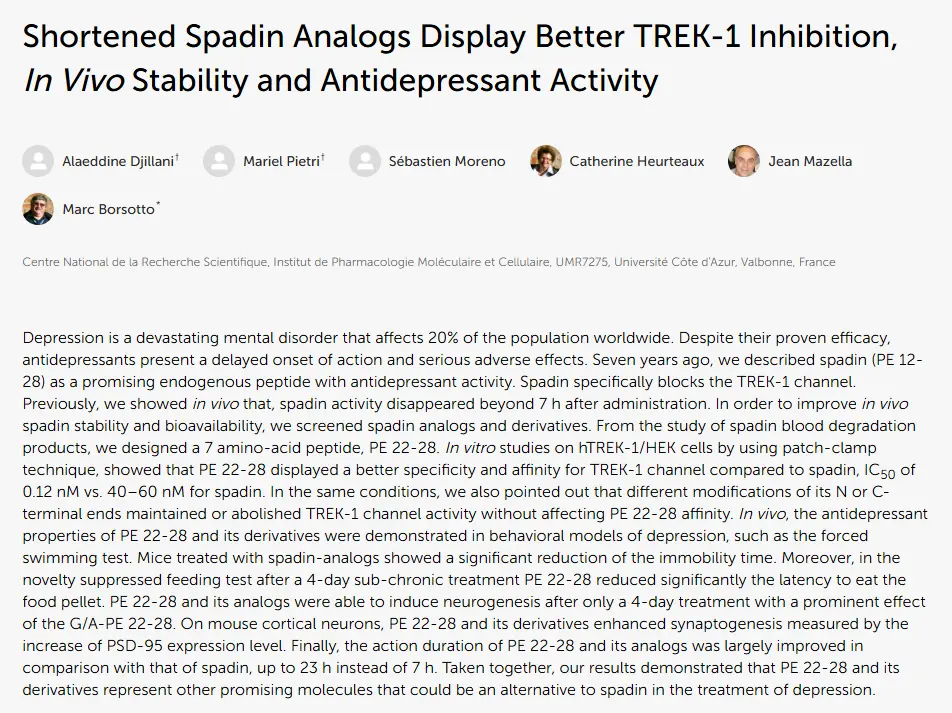
Animal experiments and in vitro studies have further validated its potential value. In a male C57BL/6J mouse model, intraperitoneal injection of PE 22-28 at a dose of 3.0 μg/kg significantly reduced the immobility time and feeding latency of mice, while promoting hippocampal neurogenesis and extending the duration of effective behaviors, clearly demonstrating antidepressant activity. In addition, this peptide can inhibit neuronal apoptosis and alleviate oxidative stress damage by regulating the CREB signaling pathway, exhibiting excellent neuroprotective effects—a characteristic that also endows it with potential in the research of neurodegenerative diseases such as Alzheimer's disease.
PE 22-28 boasts distinct advantages over traditional antidepressant drugs. Conventional SSRI drugs often take several weeks to exert therapeutic effects and are associated with notable side effects. In contrast, as a short-chain peptide analog, PE 22-28 not only acts rapidly but also showed no adverse effects on blood pressure, cardiac function and other physiological indicators in experiments. Its stable chemical properties (molecular formula: C₃₅H₅₅N₁₁O₉, molecular weight: 773.88) and good solubility also facilitate formulation preparation and application in scientific research experiments.

From the perspective of research translation, as an optimized derivative of Sortilin-derived peptides, the short-chain structure of PE 22-28 allows for easier chemical modification and analog development, providing a high-quality core sequence for the subsequent research and development of targeted drugs. To date, numerous studies have confirmed its application potential in scenarios such as post-stroke depression recovery and cognitive function improvement, with relevant findings published in authoritative journals including Neuropharmacology.
Against the backdrop of an increasing prevalence of mental health issues, the research progress of PE 22-28 undoubtedly brings new hope for therapeutic breakthroughs in related diseases. In the future, with in-depth research, this highly promising peptide molecule is expected to unlock greater value in the field of neurohealth.
Keyword:PE 22-28,1801959-12-5,PE 22-28 Bioactive Peptide,PE 22-28 Synthetic Peptide